How to Build a Coffee Table for Under $100 (Step-by-Step Guide)
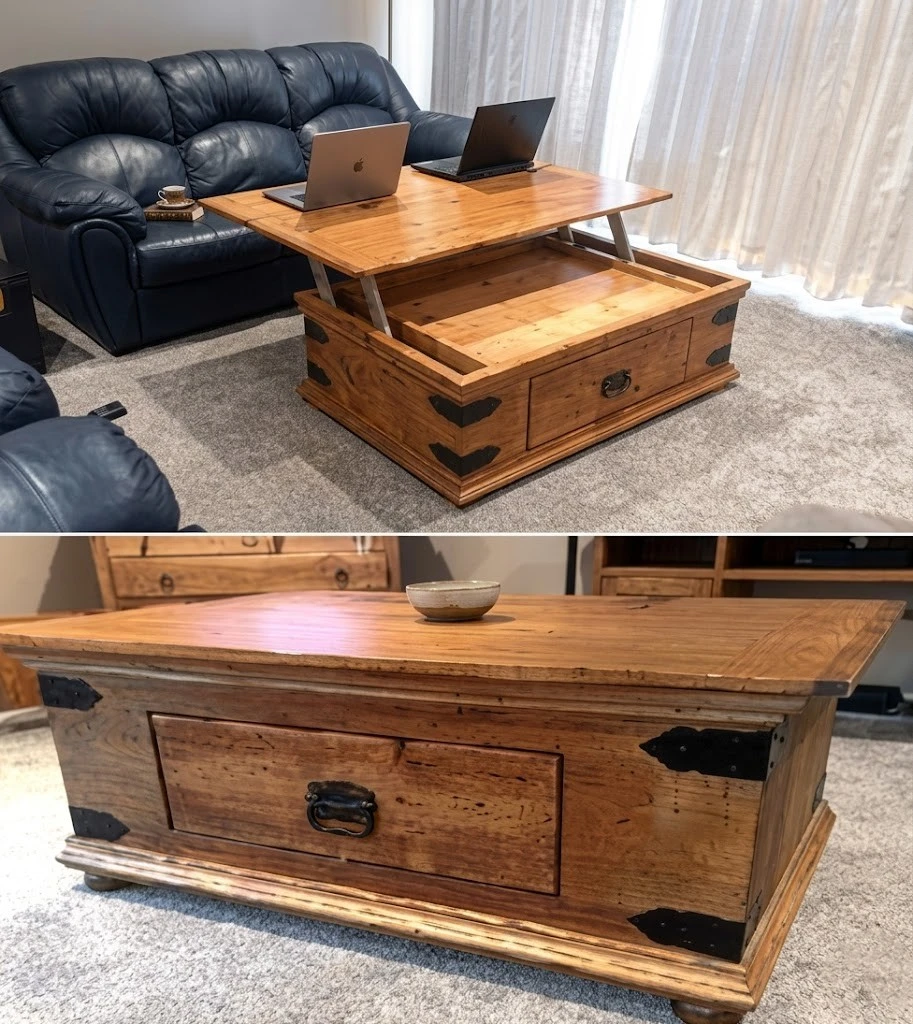
A solid wood coffee table at West Elm or Crate & Barrel runs between $600 and $1,400 for what is effectively four legs and a top. This guide shows exactly how to build a coffee table for under $100 — usually closer to $75 — using standard construction pine from Home Depot and a weekend of work. I've built three of these now. None of them cost more than $85 in materials. All three are still in daily use.
Everything here is based on real receipts and a real build. No rendered-render photos, no pretend prices. If you want to build a coffee table for under $100 that looks like it came out of a catalog, this is the exact plan.
The Design (Why Trestle, Not Farmhouse Box)
There are two coffee-table styles a beginner can realistically build to a sub-$100 budget: the box-apron farmhouse (four legs connected by four aprons, then a top) and the trestle (two end assemblies connected by a single stretcher). The box-apron is chunkier and more traditional. The trestle is leaner, modern, and — importantly for a beginner — easier to build because you're only joining two flat assemblies at the end instead of squaring up a four-leg frame in three dimensions at once.
For this coffee table under $100, the trestle is the design to use. It's about 30% faster to build, it looks great in a modern or minimalist room, and the trestle base is forgiving of small errors. A four-corner apron will wobble if any one leg is off by 1/16 inch. A trestle will still sit flat even if your cuts drift a little.
If you want the chunky farmhouse look with 4×4 legs, we have a separate plan for that — same material budget, different vibe:
Tools You'll Need for This Coffee Table
None of these tools are exotic. Everything listed is a standard entry-level option that stays under budget. If you already own most of it, you can build this coffee table for under $100 with nothing new purchased.
- Circular saw or miter saw. A miter saw is faster and more accurate for repeat cuts (essential for the four identical leg posts). If you only have a circular saw, clamp a fence — never cut freehand on parts that need to be square.
- Cordless drill/driver. Any 18V drill works. You'll use it for pocket screws and top-mount screws.
- Pocket hole jig. The Kreg R3 at $40 is more than enough. No need for the K5 at this scale.
- Orbital sander. A cheap $40 random-orbit sander saves hours versus hand-sanding a glued-up top.
- Four 24-inch bar clamps. For the top glue-up. Cheap Harbor Freight clamps are fine.
- Speed square and tape measure. Non-negotiable. A tri-square helps for checking trestle assemblies.
- Sandpaper. 80, 120, and 220 grit. Buy the multi-pack.
- Safety gear. Glasses and ear protection. Dust mask if you're indoors.
Best Wood for a Coffee Table Under $100
If you need the build to come in under $100, use construction-grade pine. It's roughly $4 per linear foot for 2×4, about $11 per 6-foot 2×8 board. Nothing else competes on price. Hardwoods like oak or walnut will triple your materials cost and push a coffee table well past $100 in lumber alone.
Here are the three practical options ranked by cost and finish quality:
| Wood | Cost for This Build | Notes |
|---|---|---|
| Standard construction pine (#2 grade) | $46 | What most of this guide assumes. Cheap, widely available, takes finish decently. |
| Select pine (knot-free, straighter) | $60 | Worth the upgrade if you're staining dark — fewer blotches, straighter edges for glue-up. |
| Poplar | $72 | Harder than pine, takes paint beautifully. Only use if painting; poplar's greenish cast looks weird clear-finished. |
For a first coffee table under $100, go with standard construction pine and pick through the stack at Home Depot for the flattest, straightest, knot-free-enough boards. Twenty minutes sorting lumber is worth it.
Important: do not use pressure-treated pine for an indoor coffee table. It's for ground contact and outdoor framing. The chemicals in pressure-treated wood are not appropriate for anything inside a home.
Materials & Real Home Depot Cost
The budget to build a coffee table for under $100 has a narrow range — $68 to $95 — and almost all the variance comes from finish choice. Here are the three real tiers based on Home Depot receipts from March 2026:
| Tier | Wood | Finish | Total |
|---|---|---|---|
| Budget | Construction pine | Mineral oil only ($6) | $68 |
| Mid | Construction pine + sanding sealer ($8) | Wipe-on poly, 2 coats ($14) | $78 |
| Premium | Select pine or poplar (+$14) | Stain ($9) + wipe-on poly ($14) | $95 |
My recommendation: the $78 build. Standard pine with a proper wipe-on poly finish. The premium tier only matters if you're staining dark, in which case select-grade pine takes stain more evenly.
Here's the full material list for the $78 mid-tier coffee table:
| Material | Qty | Cost |
|---|---|---|
| 2×8 × 6ft pine (top planks) | 3 | $32 |
| 2×4 × 8ft pine (trestle legs & feet) | 2 | $10 |
| 1×4 × 4ft pine (stretcher) | 1 | $4 |
| Pocket screws (1.5-inch, box of 50) | 1 | $9 |
| Wood glue (Titebond II) | 1 | $7 |
| Sandpaper (80 / 120 / 220) | — | $8 |
| Wipe-on poly (1 qt) | 1 | $14 |
| Mid-tier total | $78 |
Lumber prices fluctuate. Expect ±15% depending on region. If your Home Depot runs a bit pricier, you'll still come in under $100 — pine prices rarely swing enough to break that budget.
Coffee Table Cut List
Every part for the coffee table, pre-measured. Cut everything first, before any glue or screws come out. Label each piece with painter's tape so you don't lose track.
| Part | Qty | Dimensions | Notes |
|---|---|---|---|
| Top planks | 3 | 1.5" × 7.25" × 42" | 2×8 cut to 42". Edge-glue into one top. |
| Trestle leg posts | 4 | 1.5" × 3.5" × 13.5" | 2×4. Two per trestle end. |
| Trestle feet | 2 | 1.5" × 3.5" × 18" | 2×4. Runs across the floor. |
| Trestle caps | 2 | 1.5" × 3.5" × 18" | 2×4. Mirrors the foot at the top. |
| Long stretcher | 1 | 0.75" × 3.5" × 34" | 1×4. Connects the two trestle ends. |
Total lumber used: 82 linear inches of 2×8, 64 linear inches of 2×4, 34 inches of 1×4. You'll have usable offcuts for the next project. Drop these parts into our cut list optimizer to confirm the layout before you cut.
Finished dimensions: 42 inches long, 20 inches wide, 17 inches tall. Sofa arms typically sit at 23–26 inches, so 17 inches keeps the top 6–9 inches below the armrest — the conventional coffee table ratio. If your sofa sits unusually low, drop the leg posts to 11 inches. If it's a tall sectional, go up to 15 inches.
Step-by-Step Coffee Table Build
Step 1: Cut everything first
Before any glue or screws come out, cut every piece on the list. Use a stop block on your miter saw for the four leg posts — they need to be identical to within 1/32" or the coffee table will rock. If you're using a circular saw, clamp a fence; don't cut freehand. Mark cuts with a speed square and a sharp pencil. Sharp pencils matter more than you'd think at this scale.
Step 2: Glue up the plank top
The top is three 2×8 boards edge-glued into a 20.75"-wide slab. Lay the three boards on the bench, alternate the end-grain cup direction (one up, one down, one up — this resists combined cupping), apply a bead of Titebond II glue along each mating edge, clamp hard with four bar clamps, and wipe off squeeze-out with a damp rag. Let it cure at least 4 hours, ideally overnight.
Once cured, sand both faces flat with an orbital at 80 grit, then 120, then 220. Any ridges between boards sand out at 80 grit. This is the single longest step of the whole build — budget an hour for sanding the top alone.
Step 3: Build the two trestle ends
Each trestle is a small H-shape: the foot on the bottom, the cap on the top, and two leg posts between. The two leg posts sit 3 inches in from each end of the foot and cap — this leaves enough overhang that the table doesn't tip when you put a heavy book on one corner.
Drill pocket holes on the inside faces of the foot and cap (two holes per joint, four joints per trestle = eight pocket holes). Dry-fit, check square with a speed square, then glue and drive 1.5-inch pocket screws. Clamp the assembly flat while the glue dries — this prevents the trestle from racking before the glue kicks.
Step 4: Install the stretcher
The 34-inch 1×4 stretcher runs between the two trestles at mid-height, flat-side up, centered. Drill two pocket holes on each end of the stretcher. Position the trestles 36 inches apart on a flat surface, clamp the stretcher in place with a square checking both ends, and drive pocket screws into the inside face of each trestle leg.
Check the whole base for square before the glue fully cures: measure the two diagonals from the foot of one trestle to the cap of the other. If the diagonals match within 1/8", the base is square. If they don't, push one corner until they do, and re-clamp.
Step 5: Attach the top
The top is wider than the base, so it sits on top with 1 inch of overhang on the long sides and about 4 inches on the ends. Flip the top upside-down on a padded surface (a folded moving blanket works). Center the base on the underside of the top. Mark screw locations on the trestle caps — one screw near each end of each cap, so four screws total.
Important: Drill the screw holes in the caps as slots, not round holes. Wood moves across the grain with humidity — pine moves roughly 1/4 inch across a 20-inch top between winter and summer. If you pin the top rigidly at four points, it will crack along a glue line within a year. Slots let the top slide as it expands and contracts.
Cheap way to make slots: drill a round hole, then elongate it by wiggling the bit side-to-side for a few seconds. Aim for 3/8" of play in the direction of the wood grain.
Step 6: Sand and finish
Flip the table right-side-up. Final-sand the whole thing to 220 grit. Break all the sharp edges with 220 — run the sandpaper along every corner at 45 degrees for about three passes. Edges that are knife-sharp split and catch on clothing; a 1/32" chamfer lasts forever.
For finish, I recommend two coats of wipe-on poly over a pre-stain conditioner if you're staining. If you're leaving the pine natural, skip stain entirely — mineral oil or Danish oil alone ages beautifully. Apply with a clean rag, wait 15 minutes, wipe off excess. Wait 4 hours, scuff with 220, second coat. Total finish time: about 20 minutes of work spread across a day.
Common Mistakes (and How to Fix Them)
The top will have a seam line visible
Almost always. Three boards glued up don't disappear into one surface. You can minimize it by matching grain direction during the glue-up — look at each board's end grain and orient them so the rings flow in a similar direction — but a seam will still be visible under angled light. It fades once finish is applied and your brain stops looking for it.
The base will rack if you don't square it
Every. Single. Time. Pre-check both diagonals before the glue cures on the stretcher. If you skip this step, the coffee table leans and there's no fixing it without re-cutting pieces. A racked base is the single most common reason a first coffee table under $100 ends up in the garage instead of the living room.
Pine will blotch if you stain
Pine has soft rings that absorb stain unevenly. Always use a pre-stain conditioner (Minwax, $8) on pine before stain. Without it, you'll get dark splotches in random places and be unable to fix them without sanding back to bare wood.
The table will rock on tile floors
Minor rocking after assembly is almost always a tile-floor problem, not a build problem. Tiles are rarely level enough for a 4-foot-base piece. Use adhesive-backed felt pads on the bottom of each foot. If it still rocks, shave a thin sliver off the offending foot with a block plane. Don't chase this — wobble on tile is normal even on $1,200 store-bought tables.
You over-tightened the top screws and cracked the cap
2×4 pine will split if you drive a 2.5-inch screw straight into unbored end-grain near an edge. Always pre-drill the cap with a 1/8" pilot before you drive the top-mount screws. Thirty seconds of pre-drilling saves a ruined trestle.
How Long It Actually Takes
Everyone asks how long a coffee table under $100 takes to build. The honest answer: not a single-afternoon project, but close to it. Most of the wall-clock time is glue cure, not active work.
| Task | Time |
|---|---|
| Cutting all parts | 30 min |
| Top glue-up (active time) | 25 min |
| Top glue-up (cure time) | 4+ hours |
| Sanding the top flat | 45 min |
| Assembling the two trestles | 40 min |
| Installing stretcher + checking square | 25 min |
| Attaching top with slotted screws | 20 min |
| Final sanding | 30 min |
| Finishing (active time, 2 coats) | 30 min |
| Total active time | ~4.5 hrs |
Real-world this is a two-evening build or one weekend day, broken up by glue cure time.
Where to Get More Coffee Table Plans
This one coffee table under $100 is a great first furniture build, but the same skills scale up to bed frames, dining tables, bookshelves, and outdoor furniture — everything that costs $400+ at a store and $50–$120 in lumber. The difference between a hobbyist who builds one thing and a person who furnishes their entire house in solid wood is a plan library.
Buying plans one-at-a-time on Etsy runs $15–$25 each. A single done-for-you plan library pays for itself on the third project. Ted's Woodworking has 16,000+ plans — furniture, outdoor, sheds, shop fixtures — with printable cut diagrams and exact materials lists.
16,000+ Furniture Plans with Printable Cut Diagrams
Every coffee table design, from farmhouse to mid-century to industrial — with full materials lists, step-by-step assembly, and finish recipes. One-time fee, lifetime access.
Get Lifetime Access →Coffee Table FAQ
Can I really build a coffee table for under $100?
Yes, comfortably, using standard construction pine from Home Depot or Lowe's. The $78 mid-tier build in this guide is the realistic target. The only way to push past $100 is if you swap to hardwoods or buy premium stains and finishes — neither of which is necessary for a great-looking result.
Can I do this without a pocket hole jig?
Yes. Countersunk wood screws through the foot and cap into the end of each leg post will work — the joinery is just visible. If you're painting the coffee table, skip pocket holes entirely and use countersunk screws with plug cutters. If you're leaving it as natural wood, pocket screws keep everything clean-looking from every angle.
What's the biggest size I can go with this plan?
Up to 54 inches long without changing anything except the stretcher length and the top planks. Above 54 inches you'll want to add a center trestle (total three trestles across the length) to keep the top from sagging under load. The design scales linearly — wider, longer, taller — as long as you keep the stretcher-to-top ratio reasonable.
Will this hold a heavy person sitting on it?
This is a coffee table, not a bench. Pine 2×4 trestle legs will hold 200 lbs of static load easily, but dynamic loads — someone jumping up, a kid landing on the corner — will crack the pocket-screw joints over time. For seating, the answer is a bench, not a reinforced coffee table.
How long will a pine coffee table last?
Indefinitely if you re-apply finish every few years. I have a pine coffee table built 8 years ago on this same plan; it's been refinished twice, survived two moves, and looks better now than when it was new. Pine patinas well and small dings read as character, not damage.
Can I make the top wider?
Yes. Add a fourth 2×8 board to the glue-up for a 28"-wide top. You'll want a wider foot on each trestle (cut them to 22" instead of 18") so the base matches the new proportions. Materials cost goes up by about $11.
What about a lower shelf under the top?
Add a second stretcher at the bottom (or run a plank between the feet of the two trestles) and top it with a 12"-wide shelf. About $8 more in materials and 20 minutes more work. Useful for books or baskets, and doesn't push you past the $100 budget.
Is pressure-treated pine okay for an indoor coffee table?
No. Pressure-treated lumber is meant for outdoor and ground-contact use. The chemicals don't belong in a room you sit in every day. Use standard kiln-dried construction pine for indoor furniture.
Disclosure: This post contains affiliate links. If you purchase through them we may earn a small commission at no extra cost to you. We only recommend products we'd use ourselves.